
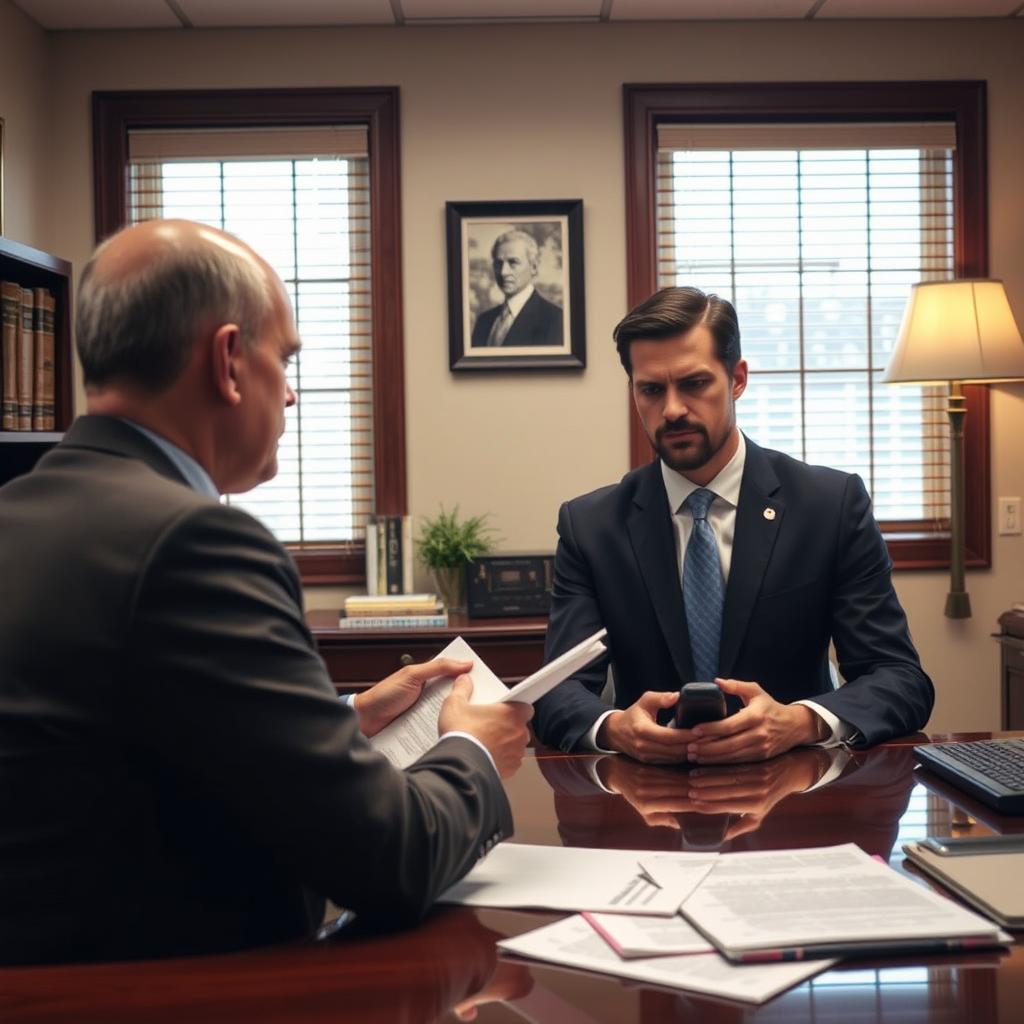
Production of Child Pornography lawyer Chesapeake, VA
A federal charge for production of child pornography is one of the most actively prosecuted offenses in the U.S. Criminal justice system. If you or someone you care about is facing investigation or indictment in the Eastern District of Virginia—the federal judicial district that covers Chesapeake, Norfolk, and the greater Hampton Roads area—you need defense counsel who has practiced in this exact environment since 1997. Law Offices Of SRIS, P.C. represents individuals targeted by child exploitation task forces, FBI field offices, and Assistant U.S. Attorneys who routinely seek mandatory-minimum prison terms under the U.S. Sentencing Guidelines. Mr. Sris, the firm’s Owner and Founder, and the firm’s Of Counsel attorneys have concentrated their practice on federal criminal defense for decades. The firm approaches every production case with a single objective: building a defense that compels the government to prove every element beyond a reasonable doubt. To request a consultation, contact Law Offices Of SRIS, P.C. at (888) 437-7747.
Law Offices Of SRIS, P.C. – Advocacy Without Borders.
What Federal Production of Child Pornography Charges Mean in Chesapeake, Virginia
A charge under 18 U.S.C. § 2251 targets the knowing employment, use, persuasion, inducement, enticement, or coercion of a minor to engage in sexually explicit conduct for the purpose of producing a visual depiction. In the Chesapeake area, these prosecutions are almost always initiated by federal agencies—typically the FBI or Homeland Security Investigations—and filed in the Norfolk Division of the U.S. District Court for the Eastern District of Virginia. Because the case proceeds in federal court rather than the Chesapeake General District Court or Circuit Court, the rules of procedure, evidence, and sentencing differ entirely from state-level sex-crime prosecutions. There is no parole in the federal system, and conviction rates for child exploitation offenses remain among the highest of any federal crime category. The U.S. Attorney’s Office pursues these cases with institutional resources that few defendants can match without experienced federal defense counsel.
Federal production charges are frequently accompanied by additional counts such as receipt, distribution, or possession of child pornography, each carrying its own mandatory-minimum sentence. The government often builds its case through executed search warrants, forensic extractions of electronic devices, IP-address tracing, and statements obtained during custodial interviews. Local residents of Chesapeake, Deep Creek, Great Bridge, and Greenbrier who are contacted by federal agents should immediately secure counsel before answering any questions, as even seemingly innocuous statements can be used to establish the knowledge and intent elements of the offense. The firm’s Richmond location, reachable at (888) 437-7747, serves clients throughout the Hampton Roads region and appears regularly in the Norfolk federal courthouse.
How Mr. Sris and the Firm’s Of Counsel Attorneys Handle Federal Production Cases
Early engagement materially affects the trajectory of a federal production investigation. Once retained, the legal team immediately notifies the U.S. Attorney’s Office and the investigating agency of representation, effectively halting direct contact between agents and the client. While the government continues its investigation, the defense begins its own parallel review: scrutinizing the warrant application for probable cause, examining the chain of custody of seized devices, and consulting digital forensic examiners when the government’s extraction methodology is open to challenge. Every motion to suppress evidence or to dismiss an indictment turns on a granular understanding of the Fourth Amendment, the federal rules of evidence, and the specific practices of the Eastern District of Virginia bench.
If the case proceeds to indictment, pretrial motion practice often includes challenges to the admissibility of electronic evidence, motions for a bill of particulars, and requests for discovery of law enforcement’s investigative notes. The defense team, led by Mr. Sris with the support of experienced Of Counsel attorneys, evaluates the government’s forensic reports for technical inaccuracies that can weaken the chain of inferences. In federal production cases, the difference between a mandatory-minimum sentence and a downward departure frequently lies in the defense’s ability to contest the government’s loss calculation, the number of images, or the applicability of certain sentencing enhancements under the U.S. Sentencing Guidelines. Because the firm has practiced in the Eastern District since 1997, the attorneys are familiar with how probation officers, prosecutors, and judges approach the guidelines in practice.
About Mr. Sris and the Firm’s Of Counsel Attorneys
Mr. Sris, the Owner and Founder of Law Offices Of SRIS, P.C., began representing federal defendants more than a quarter-century ago. A former prosecutor, he has cross-examined investigating agents and questioned the reliability of forensic evidence in federal courtrooms over the course of hundreds of proceedings. He is admitted in Virginia, Maryland, the District of Columbia, New Jersey, and New York—a five-jurisdiction practice that reflects the breadth of the firm’s federal defense work. In the legislative arena, Mr. Sris testified before the Virginia House Courts of Justice Committee in support of 2019 HB 635 (chief patron Del. David Bulova), a measure that revised the equitable distribution statute. That experience with statutory construction and courtroom advocacy informs the strategic judgment he brings to every federal case.
The firm’s Of Counsel attorneys include litigators with extensive backgrounds in federal criminal defense, many of whom have practiced in the Eastern District of Virginia for years. Collectively, the legal team has handled cases investigated by every major federal agency, from the FBI to IRS Criminal Investigation, and has developed a working knowledge of how U.S. Attorney’s Office trial teams prepare production cases for indictment and trial. When a client retains Law Offices Of SRIS, P.C., the entire team works collaboratively on the defense, ensuring that evidentiary challenges and sentencing strategy draw on multiple decades of courtroom experience.
Frequently Asked Questions
What does the government have to prove in a federal production of child pornography case?
To convict under 18 U.S.C. § 2251, the government must prove beyond a reasonable doubt that the defendant knowingly used, persuaded, induced, enticed, or coerced a minor to engage in sexually explicit conduct for the purpose of producing a visual depiction. The statute also covers a defendant who is a parent, legal guardian, or person having custody or control of a minor and knowingly permits the minor to engage in such conduct for the purpose of producing a depiction that was transported in interstate or foreign commerce. The interstate nexus is typically satisfied if the digital device or storage media was manufactured outside Virginia or, as is often the case, if the image itself traveled through the internet. A conviction requires the government to prove every element to each juror’s satisfaction. If the government cannot establish voluntariness, the minor’s age, or the necessary purpose beyond a reasonable doubt, the case may be vulnerable to a directed verdict or acquittal. Defense counsel scrutinizes each element at every stage, from grand jury to trial.
What are the sentencing consequences of a production conviction?
A first conviction for production of child pornography under § 2251(a) carries a mandatory minimum of 15 years imprisonment and a maximum of 30 years; a conviction involving a minor under 12 years of age triggers even higher statutory ranges that can reach life imprisonment. Federal sentencing under the advisory U.S. Sentencing Guidelines adds enhancements for the number of images, the age of the minor, whether the conduct involved distribution, and whether the defendant used a computer. Judicial discretion is constrained by mandatory minimums, and there is no parole in the federal system. While acceptance of responsibility can reduce the guideline range, it rarely eliminates the mandatory minimum. For this reason, a defense strategy that avoids a production conviction in the first place—whether through a motion to dismiss, a suppression ruling, or a plea to a lesser-included offense—has enormous practical value. To discuss the details of your matter, contact Law Offices Of SRIS, P.C. at (888) 437-7747.
If I have been contacted by federal agents, what should I do immediately?
Do not answer questions, do not consent to a search of your home or electronic devices, and do not discuss the investigation with anyone except an attorney who can immediately contact the agents on your behalf. Federal agents are trained to build rapport and elicit statements that can later be characterized as admissions. Even innocent explanations can be used to establish that you were present at a particular location or had access to a particular device—facts the government needs to prove its case. Once you are represented, all communication must go through your lawyer, which protects your Fifth Amendment rights and prevents the government from turning casual remarks into incriminating evidence. Time is critical; if you suspect you are under investigation in the Chesapeake area or anywhere in the Eastern District of Virginia, reach Law Offices Of SRIS, P.C. at (888) 437-7747.
Can the evidence be challenged if the FBI seized my computer or phone?
Yes, the defense can file a motion to suppress evidence if the search warrant was issued without probable cause, if the warrant was overbroad, or if agents exceeded the scope of the warrant during the search. In federal production cases, the warrant affidavit often relies on automated IP-address tracing and file-sharing network logs. An experienced defense attorney reviews the affidavit for material omissions and misleading statements that could support a Franks hearing. Additionally, the government must establish an unbroken chain of custody and demonstrate that the forensic extraction process did not alter or contaminate the data. When the government’s digital evidence contains gaps or inconsistencies, a skilled challenge can lead to the exclusion of key evidence and fundamentally alter the prosecution’s calculus. The firm’s Of Counsel attorneys have litigated these issues repeatedly in the Eastern District of Virginia and understand the local expectations of magistrate and district judges.
Why should I hire a lawyer who regularly practices in the Eastern District of Virginia?
The Eastern District of Virginia is notorious for its “rocket docket,” active prosecution, and an exceptionally high conviction rate—over 90% in many federal criminal categories, including child exploitation offenses. Local knowledge of the judges’ tendencies, the probation office’s approach to presentence reports, and the assistant U.S. Attorneys assigned to the case provides an advantage that cannot be replicated by out-of-district counsel. Familiarity with the Norfolk Division’s procedures, the timing of detention hearings, and the availability of certain pretrial diversion programs or plea negotiation practices can guide strategic decisions that affect the outcome. For a consultation about a production of child pornography charge in Chesapeake or elsewhere in the Eastern District, reach Mr. Sris and the firm’s Of Counsel attorneys at (888) 437-7747.
How does Law Offices Of SRIS, P.C. Approach a federal production case?
The firm immediately moves to protect the client’s constitutional rights, conduct an independent investigation of the government’s evidence, and craft a defense strategy that is not simply reactive to the prosecution’s timeline. This begins with a thorough intake that maps the government’s likely theory of the case. The legal team then works with forensic attorney when necessary to review the digital evidence file. Simultaneously, the defense evaluates the pre-indictment phase for opportunities to present mitigating information to the U.S. Attorney’s Office, potentially avoiding charges or minimizing the indictment’s scope. If the case is indicted, the firm’s attorneys are prepared to argue motions, engage in experienced attorney discovery, and—if beneficial—negotiate a resolution that avoids the harshest mandatory-minimum exposure. The goal in every case is to hold the government to its burden and to secure favorable outcomes under the applicable federal sentencing framework.
Explore related federal criminal defense pages:
Fairfax County Federal Criminal Defense •
Fairfax City Federal Criminal Defense •
Falls Church Federal Criminal Defense •
Prince William County Federal Criminal Defense •
Manassas Federal Criminal Defense
Further reading:
U.S. District Court, Eastern District of Virginia •
18 U.S.C. § 2251 — Production of child pornography •
U.S. Sentencing Guidelines
Attorney advertising. Prior results do not guarantee a similar outcome.
Case results depend on a variety of factors unique to each case.